
- Thurs
- 30
- Apr
- 2026
Is Your Signage Eco-Friendly? Why brands are now demanding HP Latex prints over traditional solvent printing.
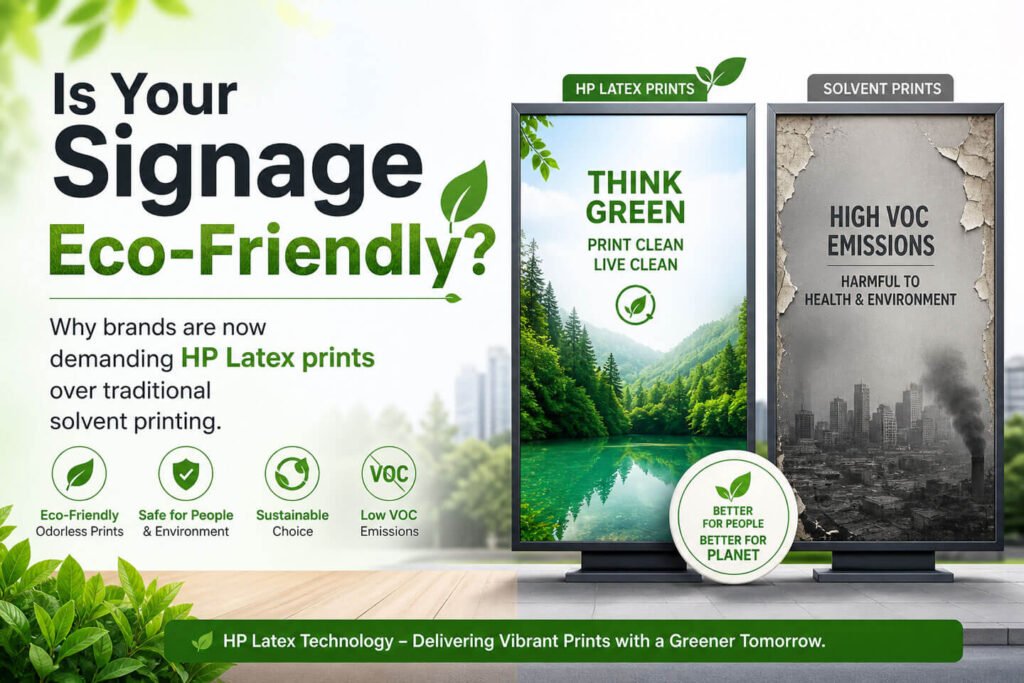
In an era where environmental sustainability is no longer just a buzzword but a core business requirement, brands are scrutinizing every part of their supply chain, including their signage. A significant shift is occurring in the large-format printing industry as companies move away from traditional solvent-based printing toward HP Latex technology. This transition is driven by a combination of health and safety benefits, unparalleled turnaround speeds, and prestigious environmental certifications that solvent inks simply cannot match.
The Move to Water-Based Innovation
Traditional solvent inks are, by definition, made of a solvent vehicle that is often hazardous and must be evaporated during the drying process. This results in the release of Volatile Organic Compounds (VOCs) and often requires special ventilation equipment to protect operators.

In contrast, HP Latex Inks are water-based, containing up to 65% water. This fundamental chemistry makes them non-flammable and non-combustible, eliminating the need for the special handling, storage, or transportation required for many solvent-based products. Because they are water-based, HP Latex prints are odorless, making them ideal for sensitive indoor environments like hospitals, schools, and daycare centers where the “new print smell” of solvent is unacceptable.
Health and Safety: No Hazard Labels Required
One of the most visible differences between these technologies is the packaging. Solvent and UV-curable inks often carry several hazard warning labels due to their chemical makeup. HP Latex Inks require no hazard warning labels and contain no Hazardous Air Pollutants (HAPs).
Furthermore, HP Latex technology avoids the problematic reactive monomer chemistry and ozone generation associated with UV printing, which can cause skin irritation and other health concerns. For brands, this means their signage isn’t just a marketing tool; it’s a commitment to the safety of their employees and customers alike.
Meeting Stringent Global Standards
Brands today are looking for proof of sustainability, and HP Latex provides a robust portfolio of certifications:
• UL GREENGUARD Gold: HP Latex Inks are certified for low chemical emissions into indoor air. Critically, they meet the highest level of this certification, allowing for unrestricted use (such as full-room wallpaper) in environments like classrooms and offices.
• UL ECOLOGO: This voluntary certification demonstrates that the ink meets rigorous lifecycle-based criteria for human health and environmental impact. HP was the first large-format printing manufacturer to earn this for latex inks.
• ZDHC Roadmap to Zero: HP Latex Inks conform to standards that ban the intentional use of over 100 hazardous chemical substances during production, contributing to cleaner air and water.

Speed and Efficiency: The Business Edge
Beyond the eco-friendly credentials, brands demand HP Latex for its operational advantages. In the world of solvent printing, media must often “degas” for 24 to 48 hours before lamination to prevent bubbles or artifacts. This creates a massive bottleneck for fast-paced marketing campaigns.
HP Latex prints come out of the printer completely dry and cured, ready for immediate finishing, lamination, or shipping. This allows print service providers to offer same-day delivery.
A Sustainable Lifecycle
The commitment to the environment extends to the equipment and consumables. The latest generations of HP Latex printers utilize HP Eco-Cartons, which replace traditional plastic cartridges with a cardboard-based design. This innovation reduces plastic consumption by 80% and achieves a 66% CO2e reduction in manufacturing and transport.

Furthermore, the printers themselves are designed with circularity in mind, with some models being up to 99.5% recyclable by weight at the end of their life. Through programs like HP Planet Partners, brands can ensure that ink bags and printheads are recycled rather than sent to a landfill.
Conclusion
For modern brands, choosing signage is no longer just about the lowest price or the brightest colors—it’s about alignment with values. By demanding HP Latex, brands can ensure their displays are odorless, safe for sensitive spaces, and backed by world-class eco-certifications. It is a rare “win-win” where the more sustainable option is also the one that provides the fastest turnaround and the most versatile application range.
Is your signage eco-friendly? If you aren’t using HP Latex, you might be leaving your brand’s sustainable reputation.


